

Prototype to production manufacturing: The short answer
Prototype to production manufacturing is the path a product takes from a working prototype to repeatable, inspected production. It runs through samples, approval gates, a pilot batch, and a documented process that any shift can follow. A prototype proves a design can work; production proves it can be built the same way every time.
This article sets out the stages, the decisions that must be frozen at each gate, and a real example: a wheelchair backrest and cushion program that moved from concept to mass production at LJ Solutions’ Vietnam facility.
Why the move from prototype to production is where launches slip
A prototype is often built by the best technician in the building, with unlimited time, from whatever material is on hand. Production is built by a line, on a schedule, from purchased materials. The gap between the two is where launches slip: materials that cannot be bought at volume, patterns that waste fabric, seams that take too long, and details nobody wrote down.
Most delays in prototype to production manufacturing come from decisions that were never formally made, not from problems that were hard to solve.
The five stages of prototype to production manufacturing
1. Concept and functional requirements
Define what the product must do: support, pressure distribution, durability, fire-retardant performance, cleaning, and fit to the chair or frame. These requirements guide every later choice.
2. Prototype and material selection
Build early prototypes to test shape and function, and select materials that meet the requirements and can be sourced reliably at production volume.
3. Sample manufacturing and fitting
Build samples on production-intent methods, fit them, test them, and refine. Each round should close specific open questions, not reopen settled ones.
4. Pilot batch manufacturing
Run a small batch on the real line, with the real materials and Work Instructions, and inspect it fully. Meet the quality control and engineering teams who run these checks. The pilot batch proves the process, produces the first inspection records, and shows the true cycle time and unit cost.
5. Production release
Release production against an approved tech pack, golden sample, and inspection plan. From here, changes go through formal change control.
What to freeze at each gate
- Before sampling: functional requirements, target cost, and approved material candidates.
- Before pilot: drawings, Bill of Materials, tech pack, and the golden sample.
- Before production: inspection criteria, packaging and labeling, and the order and forecast plan.
Each frozen decision removes one source of delay from every order that follows.
Case in point: A wheelchair backrest and cushion re-brand
The challenge
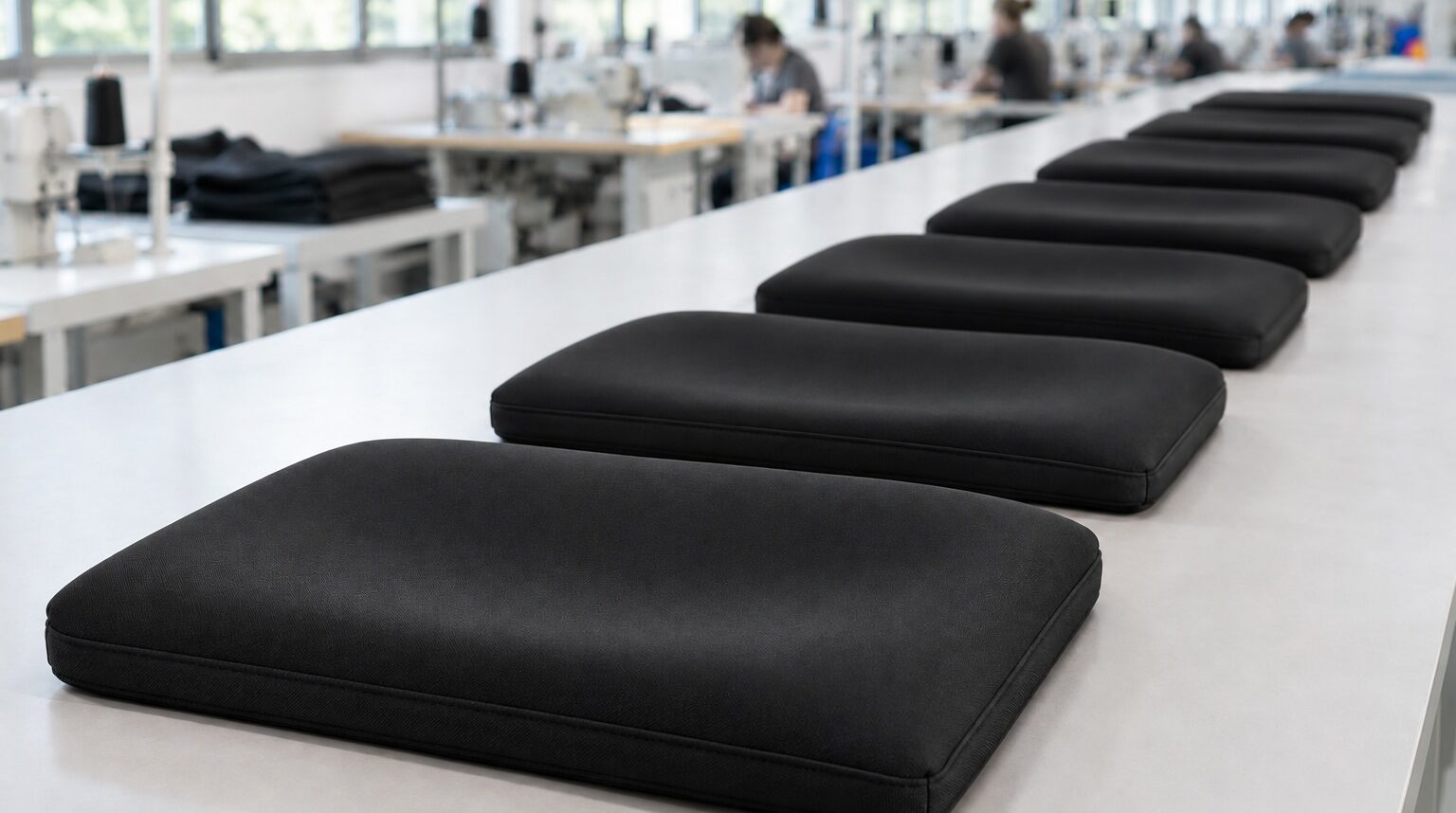
A customer needed to re-brand its wheelchair backrest and cushion. The program called for a redesign of the design itself, the materials, and the product’s functional performance, not just new labels.
The approach
LJ Solutions supported the program end to end, starting from the concept stage:
- Proposed suitable materials based on the product’s function and durability requirements.
- Took part in design consultation, functional optimization, and fitting development.
- Prepared and provided the full technical documentation (tech pack) through to final approval.
The result
Sample development took six months. The redesigned product was approved for transition into mass production, which now runs at about 40,000 pieces per year.
What made it work
The approach combined development capability from design through sampling with close customer collaboration, and technical expertise in material selection and fitting. Because the tech pack was built alongside the samples, production started from a documented package rather than from a prototype that only one team understood. How quality was held through the transition is described in our contract manufacturing quality control plan.
Signs a product is ready for prototype to production manufacturing
Before committing to production tooling and materials, check that:
- The functional requirements are written and every recent sample has been tested against them.
- All materials are approved, available at production volume, and backed by test documentation where required.
- Drawings, the Bill of Materials, and the tech pack match the latest approved sample.
- A golden sample has been signed off and stored by both parties.
- Acceptance criteria and inspection checkpoints are agreed in writing.
- A pilot batch has been built on the production line and passed inspection.
- The first-year forecast is clear enough to plan materials and capacity.
If any item on this list is still open, prototype to production manufacturing will slow down at exactly that point. Close it before the production purchase order, not after.
How to speed up the move from prototype to production
- Write functional requirements first. Material and design debates end faster when everyone tests against the same requirements.
- Choose materials you can buy at volume. Confirm material supply and test documentation during prototyping, not after. Our guide to SGS fabric testing for medical seating explains what a usable report should prove.
- Give fast, consolidated sample feedback. One set of comments per round, from all reviewers, saves weeks.
- Build the tech pack as you go. Do not leave documentation until the design is finished.
- Do not skip the pilot batch. It is the cheapest place to find a process problem.
If your drawings and BOM are already complete, the build-to-print route may be faster, because development steps are already done.
Questions to ask a partner about prototype to production manufacturing
- Which development steps can you support: concept, materials, prototyping, or documentation?
- Who prepares and owns the tech pack?
- How many sample rounds do you plan, and what does each one close?
- Will you run and inspect a pilot batch before production?
- What production volume is the process designed for?
- How are changes handled after production release?
Discuss your prototype-to-production plan
LJ Solutions focuses on programs that move into recurring production, from concept and sampling through to repeat orders. If you have a prototype, a sample, or a product that needs redesign, the team can review it, propose a sampling and pilot plan, and state the expected development steps before quotation. See our manufacturing capabilities or start with our sourcing and manufacturing services.