

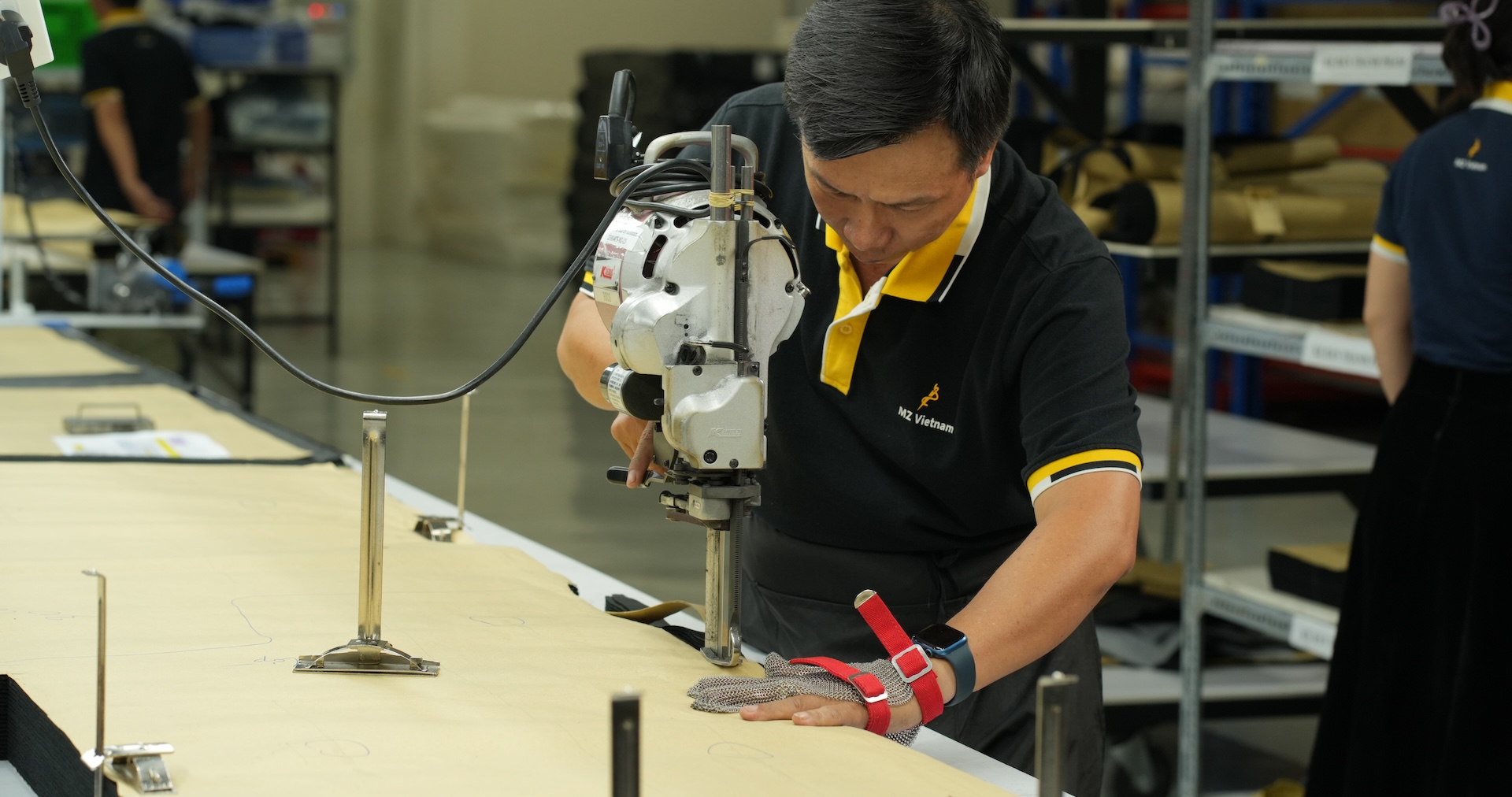
What LJ Solutions can make: the direct answer
LJ Solutions manufactures sewn, foam, and assembled components for wheelchair seating, positioning, and rehabilitation products, and coordinates CNC-machined and mechanical parts through a supplier network in Vietnam. Its own production facility in Ho Chi Minh City (registered locally as MZ Vietnam) covers cutting, sewing, foam fabrication, assembly, inspection, and packaging. If your product combines fabric, foam, webbing, and hardware, most of it can be built and checked under one program.
This page is written as a capability sheet: what equipment exists, what it is used for, and where the limits are. Capacity and lead times should be confirmed for your specific product.
Sewing: the core of the operation
Sewing is the core of the Vietnam facility’s operation and holds the largest share of its equipment:
- 60 single-needle machines for general assembly and straight stitching.
- Special sewing machines for multi-layer materials and thick fabrics.
- Automatic sewing machines for repeatable operations where consistency and productivity matter most.
- Binding machines for attaching binding tape to reinforce and finish edges.
- Double-needle, overlock, eyelet, and heat-transfer machines for parallel stitching, seam finishing, eyelets, and applying logos or labels.
Typical products include cushion covers, backrests, straps, harnesses, support pads, patient transfer slings, and wheelchair accessories. Techniques include reinforcement stitching at high-stress areas, multi-layer construction, heat-sealing and edge finishing for technical components, and precise alignment where function depends on it.
Cutting: where consistency starts
Many sewn-product defects begin at cutting, so the cutting room matters as much as the sewing line:
- Laser cutting machines with edge heat-sealing for complex shapes and fray-free edges.
- Automatic electronic thermal cutting machines for cutting and sealing webbing, Velcro, and binding.
- Straight-knife (POT) cutting machines for thick materials such as 6–8 mm neoprene.
- Marker printing and pattern cutting system for printing cutting diagrams, plus hand-operated cutting machines for multi-layer cutting against those markers.
Heat-sealed edges and printed markers are small details that directly affect repeatability from batch to batch.
Foam: cutting, shaping, bonding, and assembly
The facility’s foam process runs through pattern and jig preparation, cutting on a band-knife foam cutter, shaping, bonding, and assembly. Materials used on the cushioning side include high-resilience injected PU foam, standard PU foam, latex, memory foam, and high-density EVA foam in a range of densities and firmness levels. Components include cushions, backrests, headrests, laterals, wedges, and support pads, including multi-layer configurations.
According to the team’s material documentation, most of these foams meet CAL 117 fire-retardant standards. Buyers should still request the test documentation for the specific material and lot used in their product — see “Wheelchair Cushion Flammability Testing: CAL 117 vs. ISO 16840-10” for what to ask for.
Assembly and packaging
The assembly team brings sewn and foam parts together and integrates accessories such as positioning straps, headrests, arm supports, buckles, and hardware. Private labeling and customer packaging requirements are supported, so finished goods can ship ready for your distribution channel.
There is no fixed maximum product size. Large or complex assemblies are assessed against the design during the feasibility review.
CNC and mechanical parts through the supplier network
LJ Solutions’ Vietnam facility specializes in sewing and foam production. Mechanical work is coordinated by LJ Solutions through qualified suppliers in Vietnam, covering:
- Welding, milling, CNC machining, and drilling.
- Surface finishing such as powder coating, sand blasting, anodizing, and painting.
- Testing, inspection (including AQL sampling), and assembly.
In one product development project, LJ Solutions helped a customer modify and redesign a mechanism to optimize cost and improve function, proposed new manufacturing methods, connected the customer with the right suppliers, and provided QC on individual parts and production runs in the field. The value is not owning every machine; it is having one accountable contact across sewn and machined parts.
Capacity, lead time, and MOQ
- Capacity: at least 1,000 sewn products per day, or about 26,000 per month.
- Lead time: 30–45 days standard; 7–14 days for rush orders with limited scope. Forecast information helps shorten repeat-order lead times.
- MOQ: five-piece orders can be considered for many product types; the confirmed minimum depends on construction, material minimums, and setup effort.
- Service models: OEM (built to your drawings, specifications, or golden sample) and ODM (development support from concept, material selection, and prototyping through to production).
How the capabilities combine on real products
Most buyers do not purchase a process; they purchase a component. Here is how the equipment above typically combines on common product types:
- Wheelchair seat cushion — foam cut on the band knife, shaped and bonded to a multi-layer configuration; cover panels laser-cut or marker-cut, sewn with reinforced seams, and finished with binding; final assembly, inspection, and packaging.
- Patient transfer sling — webbing and Velcro cut and sealed on thermal cutters; body fabric cut to marker; reinforcement stitching at strap anchors and handles on special or automatic machines.
- Positioning strap or harness — heat-sealed edges, binding, eyelets, and buckle integration.
- Backrest with mounting hardware — sewn cover and foam in-house; brackets or mechanical parts machined and finished through the supplier network, then assembled and inspected together.
When a component crosses sewn, foam, and mechanical work, the interfaces between processes need the same attention as the processes themselves.
How to check whether your product fits
Before requesting a quote, it helps to answer five questions:
- Which parts of your product are sewn, foam, or mechanical, and which need to be sourced?
- What materials are specified, and do they need specific test documentation?
- Do you have drawings, a BOM, a tech pack, or a golden sample?
- What are your pilot, first-order, and annual volumes?
- Which inspection checkpoints and records does your quality team require?
A capability match is decided at the component level, not the company level. A factory can be excellent at cushion covers and still be the wrong choice for a part that needs equipment it does not have.
Request a capability review
If you are evaluating a supplier for wheelchair seating, positioning, transfer slings, or other technical sewn products, LJ Solutions can review your drawings, BOM, or sample against the equipment and processes above, then confirm which operations run in-house, which are sourced through the network, and the capacity and lead time that apply to your program.