

What makes an industrial sewing company different: the direct answer
An industrial sewing company builds functional products from technical materials — thick, coated, multi-layer, or heat-sealable fabrics, webbing, and foam — where seams carry load and dimensions affect performance. A garment factory is optimized for fashion fabrics, fast style changes, and appearance. When a seam failure is a product failure, you need a supplier whose equipment, materials experience, and production controls were built for technical work.
Vietnam has a large garment base, which is why searches for garment manufacturers in Vietnam return long lists. This article explains how to find the smaller group of suppliers ready for technical sewn products, whether that is a wheelchair cushion cover or a piece of performance outdoor gear.
Why Vietnam for industrial sewing
Textiles are one of Vietnam’s largest industrial sectors, which gives the country a deep pool of sewing skills and supporting suppliers. Two cautions come with that advantage. First, most garment capacity is built for apparel, not technical products, so the list of industrial sewing companies has to be filtered hard. Second, much of the fiber and fabric used in Vietnam is imported, so material lead time and material documentation need to be planned from the start, not after the sample is approved.
The opportunity is real, but it sits with the smaller group of suppliers set up for technical construction. For how Vietnam compares with China on sewn products, see our Vietnam vs China manufacturing comparison.
Equipment an industrial sewing company needs for technical materials
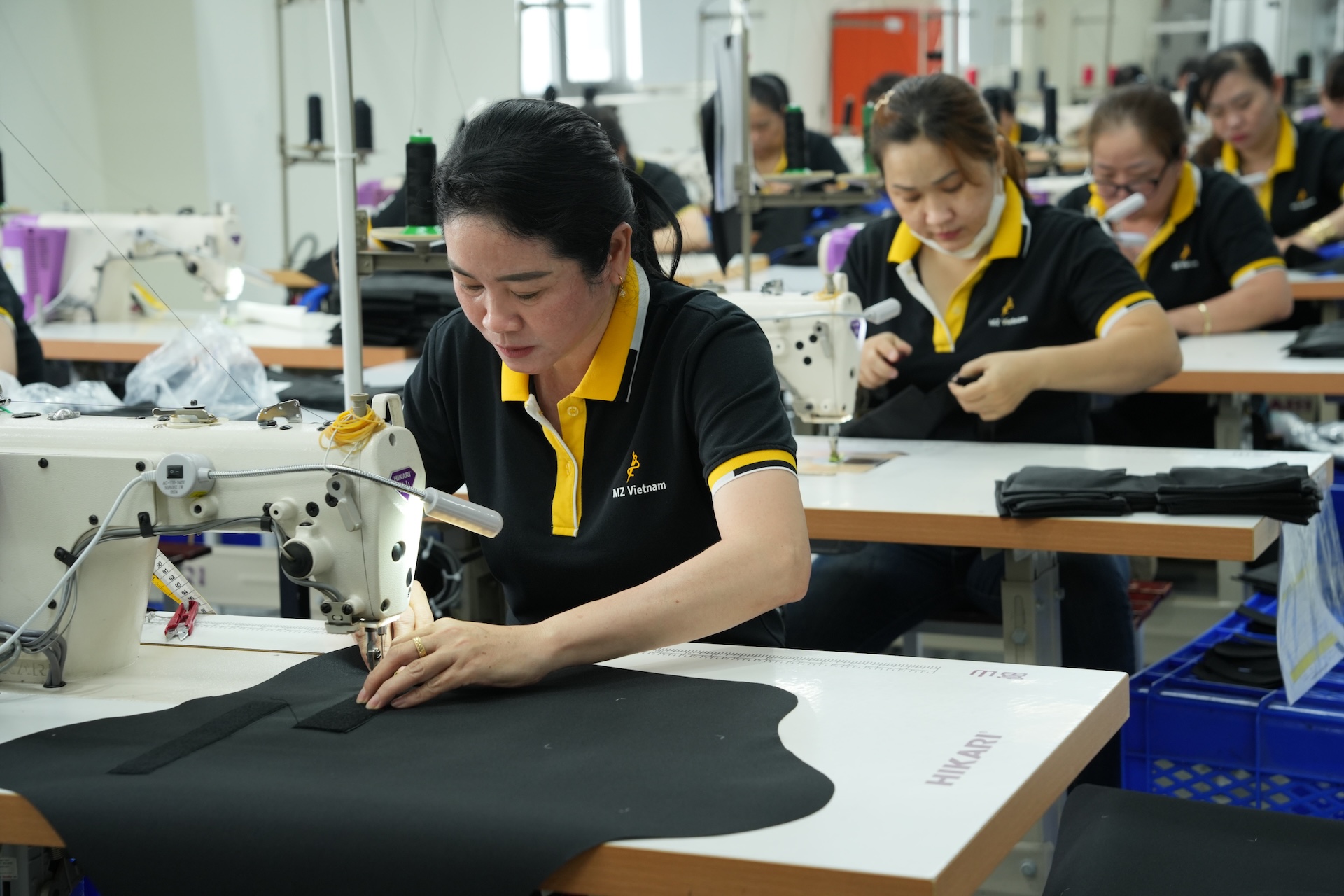
A standard garment line can be almost entirely single-needle and overlock machines. An industrial sewing company needs more. At LJ Solutions’ Vietnam facility, for example, the floor includes:
- Special sewing machines for multi-layer materials and thick fabrics.
- Automatic sewing machines for repeatable operations where consistency matters.
- Binding machines for reinforced, finished edges.
- Laser cutting with edge heat-sealing for complex shapes that should not fray.
- Automatic thermal cutting and sealing for webbing, Velcro, and binding.
- Straight-knife cutting for thick materials such as 6–8 mm neoprene.
- Marker printing for consistent layouts and material yield.
Ask what each machine is used for, not just how many machines there are. The special machines, not the machine count, show whether a supplier can handle technical construction.
Materials: experience matters more than a list
Technical materials behave differently under the needle, and an experienced industrial sewing company will know which of yours need special handling. Coated fabrics can pucker, mesh can distort, neoprene can stretch, and fire barrier fabrics can be less forgiving. Materials LJ Solutions works with for covers and sewn components include:
- Neoprene and spacer fabrics.
- Waterproof polyester with PU coating, including antimicrobial options.
- Mesh fabrics and fire barrier fabrics.
- Various nylons and Startex-type fabrics.
- Webbing, buckles, Velcro, labels, and logos.
For medical products, the team’s material documentation describes the fabrics offered as SGS-tested and CAL 117 compliant. For any market, the right question is the same: which test report covers the exact material and lot in your product? See what an SGS fabric test report should prove.
Construction techniques to confirm
- Reinforcement stitching at high-stress points, such as strap anchors and handles.
- Multi-layer construction with controlled alignment.
- Heat-sealing and edge finishing for technical components.
- Precise alignment where fit or function depends on it.
Agreeing on stitch and seam types in writing with any industrial sewing company you shortlist avoids “we thought you meant” problems. Standards such as ASTM D6193, the standard practice for stitches and seams, give buyers and suppliers a shared vocabulary for specifying construction.
Production readiness: the steps that prevent problems
Capability is what an industrial sewing company can do. Readiness is whether your product is set up to be made the same way every time. Check for:
- A complete tech pack — drawings, materials, stitch and seam specifications, tolerances, labels, and packaging.
- Patterns and markers — digital or printed layouts controlled by revision.
- Jigs and fixtures — tools that hold materials in position for consistent sewing or foam work.
- Work instructions — step-by-step instructions for each operation.
- A sample or pilot batch — produced and approved before the production purchase order.
- Inspection checkpoints — incoming, in-process, endline, and final, with records kept, as set out in a contract manufacturing quality control plan.
Skipping the pilot batch is the fastest way to discover a readiness gap at full volume.
Questions to ask an industrial sewing company before sampling
- Which machines will be used for each operation on our product, and why?
- Which of our materials have you sewn before, and what problems did you have to solve?
- How are stitch density, seam allowance, and reinforcement points specified and checked?
- How are patterns, markers, and work instructions controlled when our drawing changes?
- Where are the inspection checkpoints for our construction, and what records are kept?
- What does the pilot batch include, and what must be approved before the production order?
A supplier that answers with examples from comparable products, rather than general reassurance, is usually ready for technical work.
Small batches and scale in sewn product manufacturing
Many technical brands need small first orders and the option to scale. At LJ Solutions, five-piece orders can be considered for many product types, with the confirmed minimum depending on construction and material minimums. Sewing capacity is at least 1,000 products per day, standard lead time is 30–45 days, and rush windows of 7–14 days are possible for limited scopes. To see how MOQ and lead time affect total cost, use our landed-cost checklist.
From medical seating to performance gear
The controls that medical seating requires — documented inspection, material traceability, reinforced construction, and repeatability — are the same ones technical outdoor and performance gear brands need from an industrial sewing company for load-bearing straps, padded components, and multi-layer builds. A supplier that works to medical-grade documentation discipline brings that discipline to every sewn program.
Discuss a sewn-product program
If you are looking for an industrial sewing company in Vietnam for medical seating, rehabilitation, or technical gear components, LJ Solutions can review your tech pack, materials, and volumes and advise on readiness gaps before sampling, then confirm the equipment, construction methods, inspection checkpoints, and lead time for your product. See our sewing and manufacturing services.