

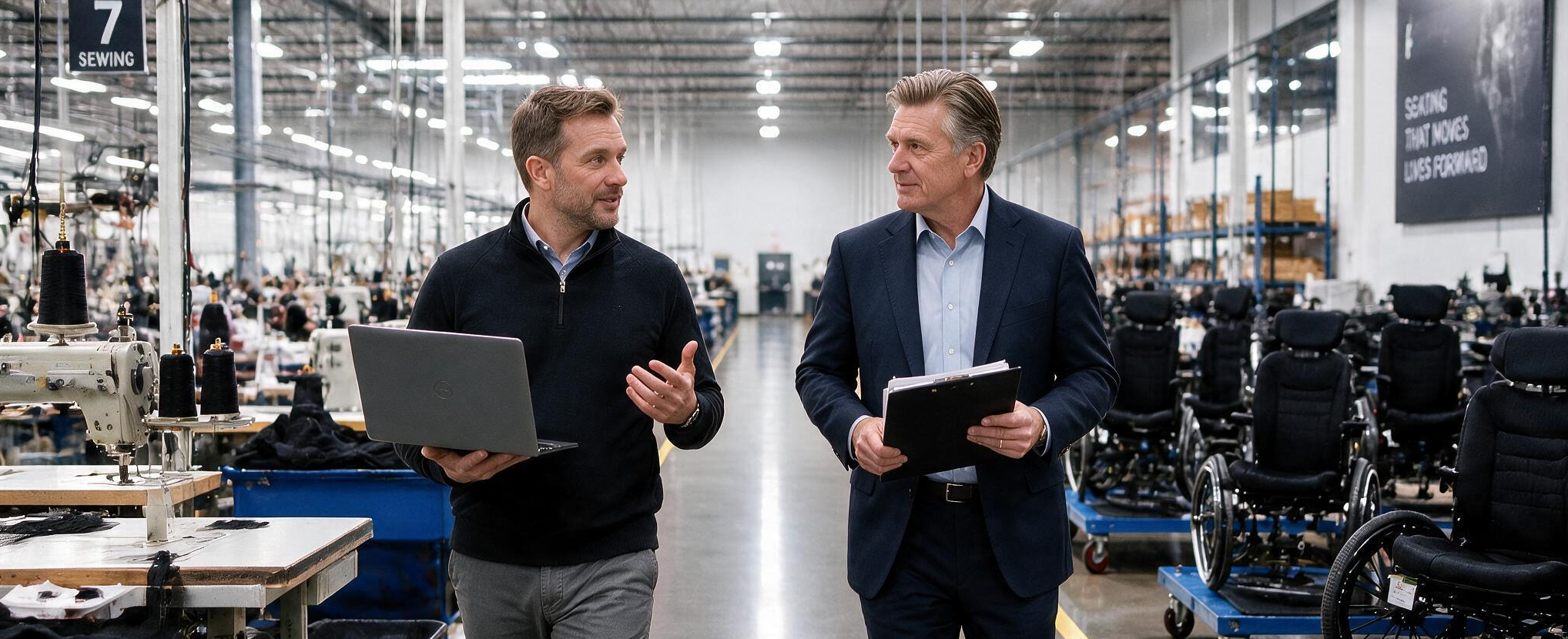
Qualifying an overseas supplier: the practical answer
Companies that outsource manufacturing to Vietnam for medical seating, mobility, or rehabilitation components need more than a competitive quotation and an attractive sample from an overseas contract manufacturer. They need to verify how the factory actually controls materials, production, and inspection day to day. A usable medical device supplier audit checklist confirms documented process control — not marketing language — before a purchase order is ever issued. For sewn, foam, and assembled components that end users depend on directly, that verification step protects both patient safety and program timelines.
Buyers evaluating a new supplier are usually doing so under pressure: a current vendor’s quality has become inconsistent, a factory audit revealed gaps, or a new product needs a manufacturing partner with sewing, foam, and assembly capability in one place. The checklist below is built for that moment — a structured way to separate a supplier that can talk about quality from one that can prove it.
Why a general factory audit isn’t enough for medical components
A wheelchair cushion cover, positioning support, or patient transfer sling is not a commodity textile product. It typically combines coated fabric, foam, webbing, buckles, labels, and reinforced stitching, and it is used by people who may be seated for extended periods or who cannot easily reposition themselves. A generic sourcing audit that checks factory size, certifications on a wall, and general capacity figures will miss the process details that actually determine whether a specific component will be produced consistently, batch after batch.
The right audit questions are specific to the product, not the category. Ask about the exact materials, tolerances, and inspection points relevant to your drawing or BOM — not a general capability statement.
The medical device supplier audit checklist: three groups of questions
Documentation and quality system controls
Every credible supplier should be able to show, not just describe, its quality system in writing.
- Does the factory maintain a documented Quality Manual, supported by Work Instructions and inspection checklists? For reference, MZ Vietnam’s production quality is governed by a documented Quality Manual, supported by Work Instructions, inspection checklists, and retained quality records — the kind of paper trail a buyer should expect to see, not just hear about.
- Which formal certifications, if any, does the supplier currently hold, and can they produce the certificate? Not every capable factory holds a facility-level certification such as ISO 13485. Confirm directly which certifications exist today versus which are aspirational, and ask what material- or process-level testing and documentation is available in their place.
- Can the supplier produce an actual inspection record from a completed order, rather than a template?
Incoming, in-process, and final inspection controls
Ask the supplier to walk through their inspection checkpoints in sequence, matched to your product’s construction:
- Incoming material inspection — how raw materials and components are checked against approved specifications (visual appearance, dimensions, functionality, supplier documentation) before they’re released to production.
- In-process inspection — checkpoints across semi-finished stages such as cutting, printing, embroidery, and accessory preparation, plus inline and endline inspection during assembly.
- Final product inspection — a pre-shipment review covering appearance, dimensions, functionality, stability, packaging, and any customer-specific requirements.
Non-conforming product, workforce, and commercial controls
- How are non-conforming parts identified, segregated, corrected, and re-inspected before they move to the next operation or ship? A vague “we fix any problems” answer is not equivalent to a controlled, recorded process.
- Is there a dedicated QA/QC team, and how often is that team trained on defect prevention, process updates, and new requirements? Ongoing, scheduled training (rather than one-time onboarding only) is a useful signal of a maturing quality culture.
- Are minimum order quantity and lead time figures confirmed against your specific product and materials, rather than quoted as a flat company-wide number? Standard production lead time in the 30–45 day range, with shorter windows available for limited rush scopes, is a reasonable industry benchmark to compare a quote against — but any figure should be confirmed for your scope before it’s treated as a commitment.
Red flags that should end a supplier conversation
- The supplier cannot describe how a defect found mid-production is documented and corrected.
- Certification claims are made verbally but no certificate or scope document is produced on request.
- Inspection is described only as a single check at the very end of the line, with no earlier checkpoints.
- MOQ or lead-time figures shift materially once you ask for a written quotation.
- There is no clear answer to who owns communication and escalation when something goes wrong.
What a 30-minute supplier audit call should cover
You don’t need an on-site visit to apply most of this checklist. A focused 30-minute call with the supplier’s quality or production lead can cover:
- A walk-through of the Quality Manual or equivalent documented procedure, section by section relevant to your product.
- A description of the last non-conforming batch they caught, how it was corrected, and how it was recorded.
- Confirmation of which inspection checkpoints apply to your specific construction — not a generic list.
- A request for one anonymized inspection record from a recent, comparable order.
- Direct confirmation of MOQ, standard lead time, and rush-order options for your product and volume.
A supplier that answers all five with specifics, rather than reassurances, has usually earned the right to quote your program.
Turning the checklist into a qualification decision
An audit checklist is only useful if it changes a decision — and that’s especially true the first time a company decides to outsource manufacturing to Vietnam rather than continue with a domestic or incumbent supplier. Score each supplier against the same documentation, inspection, and communication criteria, and weight the results by how closely they match your product’s actual construction and risk profile — not by price alone. A lower quotation from a supplier that cannot evidence its inspection process typically costs more once rework, delays, and quality escapes are counted.
If you are qualifying an overseas manufacturer for wheelchair seating, rehabilitation components, or other technical sewn products, LJ Solutions can walk through this checklist against your specific drawings, BOM, and volume expectations, and coordinate a capability and QA review with its manufacturing partner. MZ Vietnam can then confirm, in writing, which of these controls apply to your program before a quotation is issued.
References
- The FDA Group. “Supplier Auditing in Medical Device Manufacturing.” thefdagroup.com, 2025. https://www.thefdagroup.com/blog/supplier-auditing
- Greenlight Guru. “Internal Audit Checklist for Medical Device Companies.” greenlight.guru, 2025. https://www.greenlight.guru/blog/internal-audit-checklist-medical-device
- SimplerQMS. “Medical Device Supplier Management.” simplerqms.com, 2025. https://simplerqms.com/medical-device-supplier-management/