

Vietnam vs. China manufacturing: the practical answer
For medical seating and technical sewn products, neither Vietnam nor China is automatically the better manufacturing location. China offers an exceptionally broad and mature industrial base. Vietnam can be a strong fit for labor-intensive technical sewing, customized assemblies, flexible production, and companies seeking to diversify supply.
The right decision depends less on national averages and more on the fit between your product and the supplier’s actual processes. Buyers should compare material capability, quality controls, minimum order quantities, lead times, communication, and total landed cost—not labor rates alone.
Why technical sewn manufacturing needs a product-specific comparison
A wheelchair cushion cover, positioning support, transfer sling, or multi-layer technical assembly is not a commodity garment. The product may combine coated fabric, mesh, neoprene, webbing, hook-and-loop material, foam, labels, buckles, and reinforced stitching. Each layer introduces requirements for cutting, handling, alignment, seam construction, inspection, and documentation.
A country-level comparison is only the beginning. Teams need to know whether a specific manufacturer can:
- Process both soft and thick technical materials consistently.
- Control cutting patterns, stitch construction, dimensions, and assembly details.
- Integrate foam, straps, accessories, labels, and packaging.
- Work from controlled drawings, specifications, bills of materials, or approved samples.
- Document incoming, in-process, endline, and final inspections.
A lower hourly labor rate has limited value if material waste, rework, expedited freight, or inconsistent output increases the total program cost.
Vietnam manufacturing vs. China manufacturing: six decision criteria
1. Supplier ecosystem and technical specialization
China’s industrial ecosystem is larger and deeper across many categories. Buyers can often find dense clusters of material suppliers, tooling specialists, factories, and logistics providers. That breadth may benefit products requiring highly specialized inputs, complex tooling, electronics, or very large-scale integrated supply chains.
Vietnam’s manufacturing base is smaller, but it has become an important alternative for global supply chains. U.S. trade guidance identifies competitive labor costs, strategic location, foreign investment, and a broad free-trade-agreement network among the factors supporting Vietnam’s manufacturing growth. For technical sewn products, the key question is whether the selected Vietnamese operation has the required equipment, material experience, and supplier relationships.
2. Labor, conversion cost, and total manufacturing economics
Vietnam is often considered for its competitive production economics, especially for labor-intensive work. However, buyers should avoid assuming that every product will cost less in Vietnam. Fabric yield, foam conversion, accessory sourcing, quality requirements, production volume, and shipping mode all affect the result.
China may offer better economics when scale, automation, local component availability, or supplier concentration offsets a higher quoted conversion cost. Vietnam may be competitive when skilled technical sewing and flexible labor are more important than a massive upstream ecosystem.
Compare complete quotations and landed-cost assumptions rather than relying on a country-level wage comparison.
3. Minimum order quantity and production flexibility
Medical seating and rehabilitation programs may start with samples, pilot batches, replacement components, or multiple product variations. A factory optimized only for long, high-volume runs may not be commercially or operationally suitable.
Ask suppliers in either country how they calculate minimum order quantities. Material suppliers may impose minimums that differ from the factory’s production MOQ. Color, coating, foam density, printed labels, packaging, and hardware can each create separate minimum-purchase requirements.
MZ Vietnam may support small production runs in selected cases. The factory confirms MOQ after reviewing the product, materials, and required setup. This is more useful than an unqualified “low MOQ” promise.
4. Quality control for medical seating components
Quality should be evaluated as a managed process. Review how the supplier approves incoming materials, controls production specifications, detects non-conforming work, reinspects corrections, and releases finished goods.
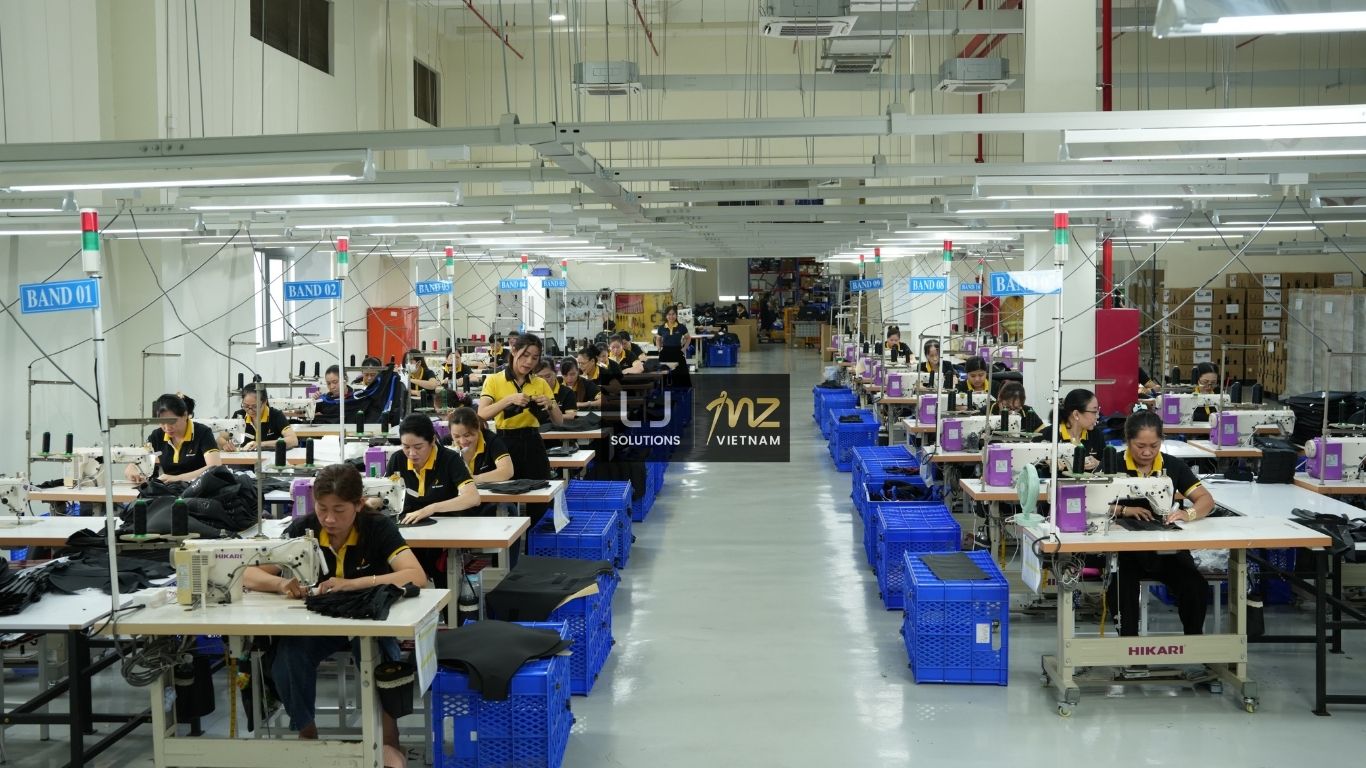
At MZ Vietnam, production quality is governed by a written quality framework. Task instructions, inspection forms, and retained quality records support its implementation. Control points cover material receipt, cutting, printing, embroidery, accessory preparation, sewing, assembly, end-of-line review, and shipment release. The final review can address visual condition, measurements, intended operation, stability, packing, and criteria defined by the customer.
These controls are evidence of an operating approach, not a claim that every product is automatically certified or compliant. The customer remains responsible for defining applicable regulatory and product requirements.
5. Lead time, forecasting, and supply continuity
Quoted production lead time should be separated from material procurement, sample approval, export preparation, freight, customs clearance, and delivery to the buyer’s facility. A short factory lead time does not necessarily mean a short replenishment cycle.
Current guidance from MZ Vietnam places routine production at approximately 30–45 days after scope and capacity are confirmed. Complexity, input availability, and volume can change that estimate. Forecasts help reserve materials and avoid delays. Accelerated production may be available for limited scopes, but it is not a substitute for normal planning.
China’s greater supplier density may shorten certain input lead times. Vietnam can still support predictable programs when forecasts, approved materials, order cadence, and escalation ownership are established early.
6. Communication and offshore manufacturing support
Communication problems are not unique to either country. They usually arise when responsibilities, revision control, technical decisions, and escalation paths are unclear.
MZ Vietnam and LJ Solutions operate through a combined offshore–onshore model. LJ Solutions handles customer communication and sourcing coordination from Canada, while MZ Vietnam manages manufacturing and quality activities in Vietnam. The arrangement is intended to make communication easier while keeping factory decisions close to the manufacturing floor.
When Vietnam may be the stronger manufacturing fit
Vietnam deserves serious consideration when the program involves:
- Labor-intensive technical sewing or multi-material assemblies.
- Customized products manufactured from drawings, a BOM, specifications, or a sample.
- A need to diversify production beyond one country.
- Pilot-to-repeat production with realistic forecast visibility.
- A buyer that values local supplier coordination and in-market quality oversight.
When China may still be the better choice
China may remain the stronger option when a product depends on a highly concentrated local supply base, advanced tooling, specialized electronics, extreme production scale, or a component ecosystem that would otherwise need to be recreated across borders.
The comparison should not become a simplistic “China out, Vietnam in” decision. Some buyers use a dual-country or staged strategy, assigning programs according to supplier strength, risk, and product maturity.
A seven-question supplier and country checklist
Before choosing a location, ask:
- Does the factory have proven experience with our materials and product construction?
- Which processes occur in-house, and which depend on subcontractors?
- How are drawings, BOM revisions, material substitutions, and approved samples controlled?
- What inspections and records will apply to our product?
- Which material, production, or packaging minimums affect the MOQ?
- What is the full lead time from material commitment to delivered inventory?
- What does the landed-cost comparison include—and what remains excluded?
Choose the supplier model, not just the country
Vietnam can be a compelling manufacturing location for medical seating and technical sewn products, but the strongest decision is based on product-specific evidence. Evaluate equipment, materials, quality controls, communication, commercial assumptions, and supply continuity together.
If you are comparing Vietnam and China for a sewn or assembled product, LJ Solutions can assess your drawings, BOM, forecast, and manufacturing fit; as well as review your sourcing priorities and coordinates the overall discussion.
References
- International Trade Administration. “Vietnam—Market Opportunities.” U.S. Department of Commerce, updated 2026. https://www.trade.gov/country-commercial-guides/vietnam-market-opportunities
- International Trade Administration. “Vietnam—Market Overview.” U.S. Department of Commerce, updated March 26, 2026. https://www.trade.gov/knowledge-product/exporting-vietnam-market-overview
- World Bank. Light Manufacturing in Vietnam: Creating Jobs and Prosperity in a Middle-Income Economy. World Bank, 2013. https://documents1.worldbank.org/curated/ar/116451468126895451/pdf/Light-manufacturing-in-Vietnam-creating-jobs-and-prosperity-in-a-middle-income-economy.pdf