

notices a problem, who has authority to stop it, and who writes it down?
A dedicated QA/QC team means quality has its own headcount rather than being an extra duty for production supervisors. Dedicated quality staff is one of the clearest signals that inspection happens at every checkpoint, not only when a customer is watching.
The QA/QC team: what they check and when
The QA/QC team works through the checkpoints defined in the Quality Manual, Work Instructions, and inspection checklists:
- Incoming material inspection — fabrics, foams, webbing, and accessories are checked against approved specifications for appearance, dimensions, function, and supplier documentation. Only qualified materials are released to production.
- Semi-finished inspection — checks at cutting, printing, embroidery, and accessory preparation.
- Inline and endline inspection — workmanship, dimensions, and assembly accuracy during sewing and assembly, and a review of each assembled unit before packaging.
- Final product inspection — appearance, dimensions, function, stability, packaging, and customer-specific requirements before shipment.
When something does not conform, the team identifies it, has it corrected, and re-inspects it before it moves to the next operation. The result is kept as a quality record, which is what a buyer should ask to see.
How the quality team is trained
QA/QC staff take part in the ongoing monthly training program on quality control, defect prevention, and process changes, and in specialized training on quality management, internal audit, 5S, and Kaizen. Competency is confirmed through job performance assessment rather than internal certificates, which is worth knowing if your supplier questionnaire asks for training records.
The engineering team: from drawing to tech pack
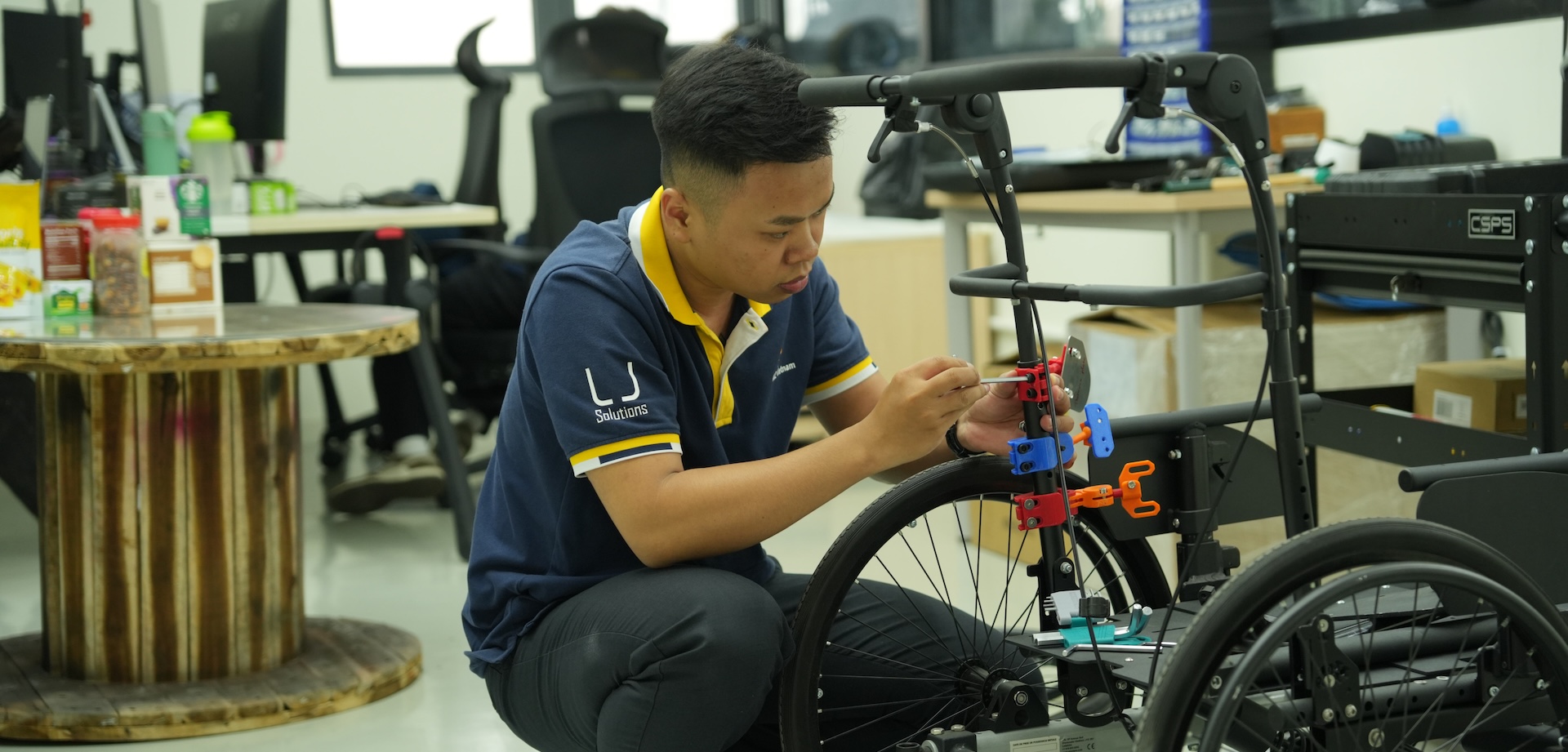
The engineering team in Vietnam works at the front of a program, where most quality problems are either prevented or built in:
- Reviewing customer drawings, specifications, BOMs, and golden samples for manufacturability.
- Proposing materials suited to the product’s function and durability requirements.
- Supporting design consultation, fitting, and functional optimization during sampling.
- Preparing full technical documentation, including the tech pack, through to customer approval.
Engineering decisions made before the first sample decide most of the quality you will see in production.
Case in point: a backrest and cushion redesign
In one project, a customer needed its wheelchair backrest and cushion redesigned in terms of design, materials, and function as part of a re-branding. LJ Solutions supported the work from concept: proposing materials, taking part in design consultation and fitting development, and preparing a complete tech pack until final approval. Sample development took six months, and the product moved into mass production at about 40,000 pieces per year.
The Canadian team: engineering review and field QC
On the Canadian side, LJ Solutions leads the first technical conversation. It reviews the documentation you submit, gives engineering feedback on design changes or material substitutions, and makes sure updated drawings come back to you for approval before anything is quoted.
For CNC-machined and other mechanical parts made by suppliers in the network, LJ Solutions provides QC on individual parts or production runs in the field. Its engineers work with engineering software and follow international engineering and QC practices, including AQL sampling during production inspection.
How the teams hand off across a program
Quality and engineering are involved at different moments, and knowing when each team leads helps you direct questions to the right people:
- Submission and feasibility — LJ Solutions’ engineers in Canada and Vietnam review drawings, BOM, and samples for manufacturability and material fit.
- Engineering feedback and package finalization — engineering proposes changes; updated drawings go back to you for approval.
- Sampling and pilot batch — engineering supports fitting and functional optimization; QA/QC checks samples against the approved specification.
- Production — QA/QC runs incoming, in-process, endline, and final inspection, and keeps the records for each order.
- Changes and improvements — engineering updates documentation; affected operators and inspectors are retrained before the change runs.
Clear handoffs are what stop a quality question from bouncing between departments while production keeps running.
What the teams do not claim
- LJ Solutions does not currently claim a facility-level certification such as ISO 13485 for its Vietnam facility. The evidence available is the Quality Manual, Work Instructions, inspection checklists, quality records, and material test documentation.
- Material testing (for example, fire-retardancy or antibacterial testing) is supported with documentation for the materials used; the customer defines which tests the finished device requires.
Questions to ask on your first call with the team
- Which checkpoints in the Quality Manual apply to our product’s construction?
- Can you walk us through one anonymized inspection record from a comparable order?
- How was the last non-conformance on a similar product found, corrected, and recorded?
- Who reviews our drawings, and what feedback did engineering give on a recent project?
- Who is our contact if an issue is found during production, and how quickly are we told?
Meet the team behind your parts
If you are evaluating a supplier for medical seating or rehabilitation components, LJ Solutions can set up a QA and engineering introduction call around your drawings or sample. Its quality and engineering leads in Vietnam will walk through the checkpoints, records, and development steps that would apply to your program before a quotation is issued.